
Verify Fairland Voter Registration Online
The Maryland Voter Lookup lets an individual review their own Fairland voter registration. It is not an open list that accepts any person's name. The required personal facts act as an identity check. Enter the name in the form used at registration, then supply the birth date and residential ZIP. Street number and middle initial can help the service distinguish the record.
| Lookup field | Input | Required | Accepted form |
|---|---|---|---|
| First Name | Text | Yes | Registered form; letters and spaces |
| Last Name | Text | Yes | Letters, hyphens, and spaces |
| Date of Birth | MM, DD, YYYY | Yes | Separate month, day, and year boxes |
| ZIP Code | Five digits | Yes | Maryland residential ZIP on the record |
| Street Number | Text | Conditional | Residential number; letters and fractions need not be entered |
| Middle Initial | Text | No | As recorded |
Use the Search control after checking each entry. A recent online or motor-vehicle registration can take up to three weeks to appear. After a move, try the former ZIP; after a name change, try the former registered name. If the result remains wrong, contact the local board rather than treating a no-match as final.
The official Fairland voter registration lookup screen shows why the service needs more than a name.
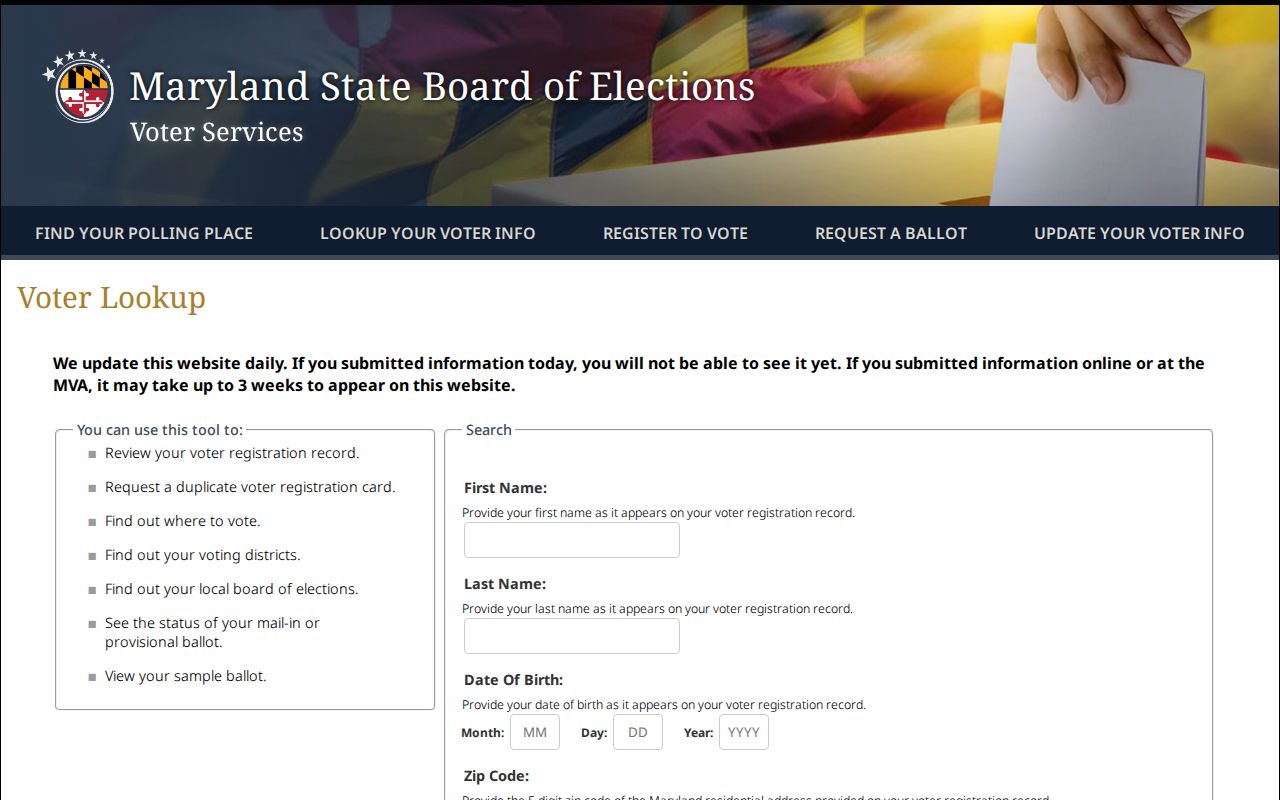
Its field layout reinforces that the tool is designed for a voter checking a known record, not for browsing people.
Fairland Voter Lookup Results
A successful match opens a set of election services. The voter can review the registration record, find the polling place and voting districts, identify the local board, view a sample ballot, follow mail-in or provisional ballot status, and request a duplicate voter-registration card. These functions are tied to the authenticated record.
- Registration status and the voter's own record
- Polling place and assigned voting districts
- Montgomery County local board information
- Mail-in or provisional ballot status
- Sample ballot and duplicate-card service
Ballot participation is not ballot choice. Election history may show that a person voted, when, and by what method, but a secret ballot is never joined to the voter record. Candidate and question selections do not appear.
Fairland Voter Records Custodians
Fairland is an unincorporated census-designated place. It has no city election clerk or municipal voter roll. The Montgomery County Board of Elections is the local custodian, while the Maryland State Board of Elections runs the statewide lookup and data program. Check the county contact page for current public hours before visiting.
Montgomery County Board of Elections
18753 N. Frederick Avenue, Suite 210
Gaithersburg, MD 20879
240-777-VOTE (8683)
Maryland Relay 711
Maryland State Board of Elections
151 West Street, Suite 200
Annapolis, MD 21401
410-269-2840
800-222-8683
The Montgomery County elections service page provides the local starting point for a Fairland voter.
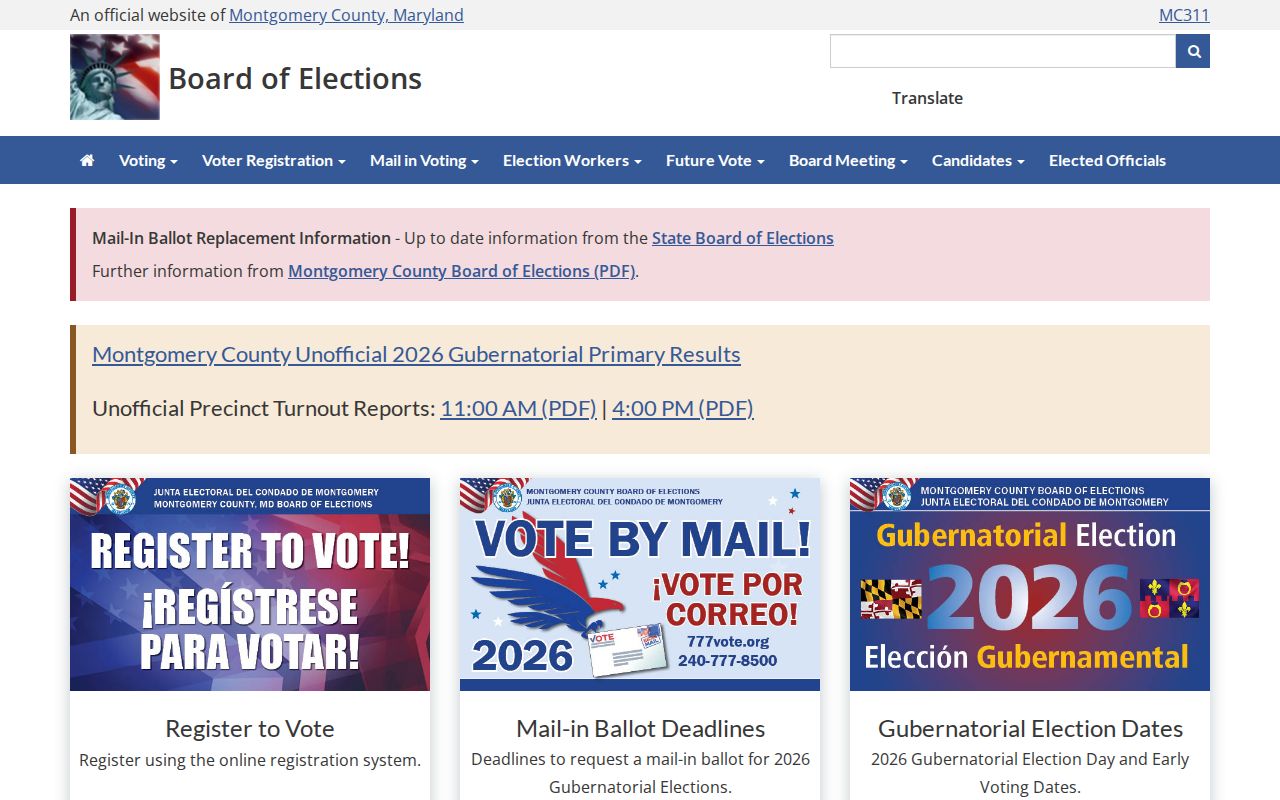
This county channel matters when a protected record or a recent update cannot be handled through online self-service.
Note: Fairland is not a separately priced municipality in the state data program, so ask which county, precinct, or district selection fits the need.
Fields in Maryland Voter Records
The full registered-voter product is far richer than a self-lookup result. Its columns can place a registered person within election geography and show how the record is administered. The precise fields vary by chosen product, so do not treat every list as interchangeable.
| Identity | Voter ID, name, party, and gender |
|---|---|
| Addresses | Residential and mailing addresses, subject to protected-address rules |
| Status | Active or inactive status plus state and county registration dates |
| Precinct | Split and precinct assignment |
| Districts | Congressional, legislative, councilmanic, ward, municipal, and commissioner fields when applicable |
| History product | Election, method, date voted, precinct, early-voting site, jurisdiction, and county |
Walking lists are organized another way. They are uneditable precinct PDFs, sorted by street address, with voters at each address and party shown. Even-numbered addresses appear in one column and odd-numbered addresses in the other. A walking list is not available statewide.
Confidential Fairland Voter Information
Election Law §3-505 opens registration records held by a local board for inspection during its public hours, subject to special orders and confidentiality law. Election Law §3-506 places tighter rules on copies. Full Social Security numbers, motor-vehicle credentials, and signatures are verification data, not ordinary public list columns.
Protected by law. Family Law §4-527, State Government §7-309, and Election Law §3-506 prevent release of a Safe at Home participant's residence address in voter-list copies. Other qualifying confidential voters can also be removed from public Voter Lookup.
A confidential designation can disable some online voter services. The voter then works with the Montgomery County board. Safe at Home protection does not require a second election confidentiality filing merely to shield the participant's residence address.
Maryland Voter File Products
The revised state application offers several distinct products. Registered voter, walking, permanent mail-in applicant, single-election mail-in, provisional, early-voting, cure, and voting-history files answer different election needs. Mail-in applicant data does not prove that a ballot was cast; actual participation belongs in voting history.
The State Board's voter-data rules and pricing page explains those choices and their limits.
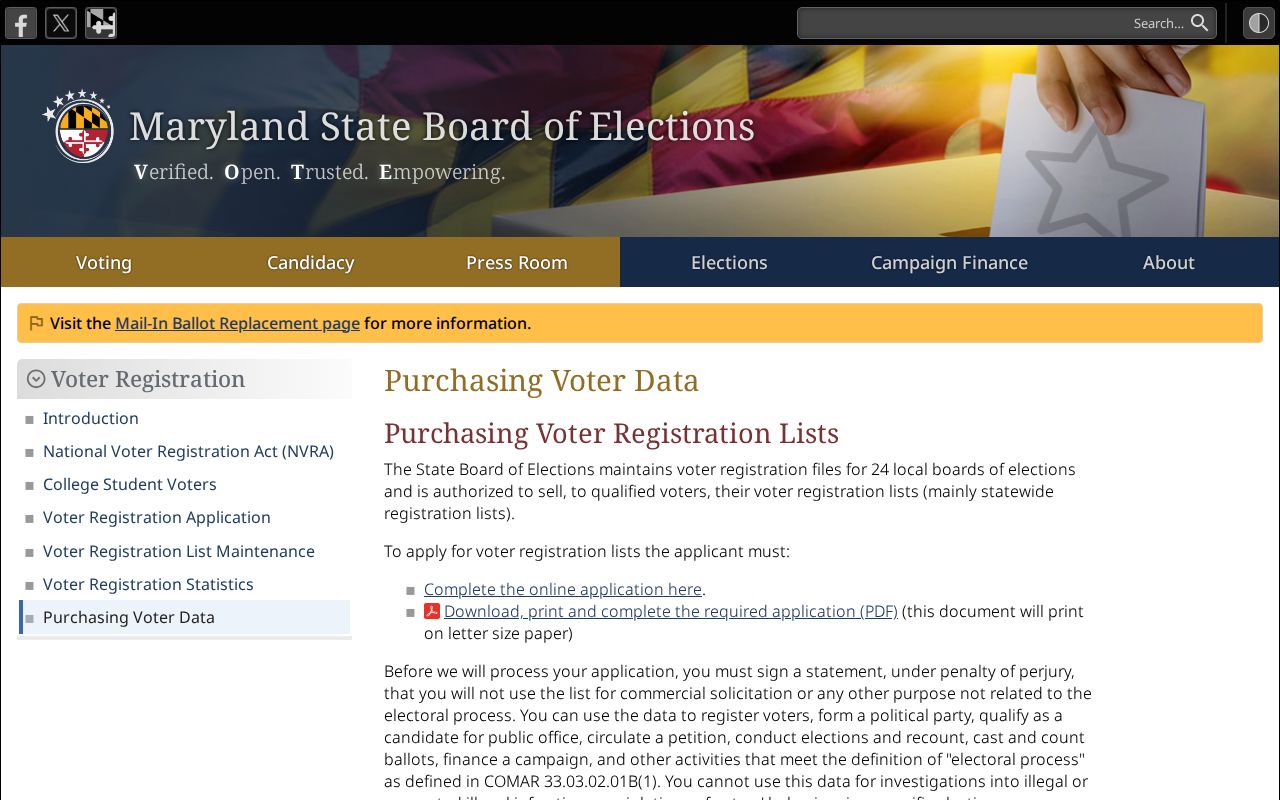
The official screen is the current source to check before filing because products, forms, and operating details can change.
History may be added to a registered list, with a statewide selection capped at five elections, or ordered as a separate table. That separate file joins back to the main list by voter ID. Early-voting, provisional, and cure products contain fields specific to those processes.
Order a Maryland Voter File
Election Law §3-506 permits a copy to a Maryland registered voter who files a written application and swears that the data will serve an electoral-process purpose. It cannot be obtained as a commercial directory. The current process runs through the State Board of Elections and its Application for Voter Registration Data.
- Choose a statewide, single-county, Baltimore City, or district region and select each needed product.
- Give the applicant's registration and contact details, plus organization information when purchasing for one.
- Select active-only, date-range, party, or all-voter limits, then choose FTP, pickup, or mailed delivery.
- Sign the sworn noncommercial and electoral-purpose statement and submit full payment with the form.
A statewide report costs $125. One county or district costs $75. FTP waives the $3 setup fee; a flash drive adds $1.75 and mailing adds $15. The board states a turnaround within 10 working days after receipt. Applications must arrive on or before the advanced registration deadline, 21 days before an election, or after election day. A late application in that closed span is returned.
Non-walking files arrive as tab-separated text with no text delimiter. Large statewide or district files may exceed common spreadsheet limits, and SBE does not promise software compatibility, import help, or a custom layout.
Fairland Voter Record Use Limits
The application oath bars commercial solicitation and any use unrelated to the electoral process defined in COMAR 33.03.02.01B(1). Permitted examples concern voter registration, party formation, candidate qualification, petitions, election or recount activity, ballot administration, and campaign finance. The state also bars use of its data to investigate alleged illegal voter behavior in a specific election.
Use has legal limits. Knowing non-electoral use is a misdemeanor under Election Law §3-506(c), with 30 days to six months in jail, a fine up to $250, or both; the signed oath also invokes perjury.
Never use another person's facts to enter self-service lookup or alter another registration. Public availability also does not permit intimidation, repeated unwanted contact, or publication of protected data. Maryland harassment and stalking laws may apply to harmful conduct. General records-law context belongs with Fairland public records access, while voter-file restrictions remain controlled by election law.
Fairland Registration Status Changes
Active, inactive, and canceled are distinct conditions. A move within Maryland does not by itself require a new registration while the person remains registered, but the address should be updated. An inactive label is not proof that a voter moved away or lost eligibility. Contact the local board for the record-specific answer.
County boards use official information and notices under state law and federal safeguards. When a Social Security death report matches a voter, the election director mails notice to the registered address. Without an objection or a showing of cause within two weeks, the registration is canceled. A timely response can stop removal or lead to a local-board hearing. Other confirmation procedures also observe federal limits on systematic removal near a federal election.
Montgomery Voter Statistics Context
The Maryland voter registration statistics page publishes monthly activity reports and yearly totals by jurisdiction and party. Those reports usually carry about a three-week lag. Montgomery County figures provide sound context for Fairland, but they are not a Fairland count.
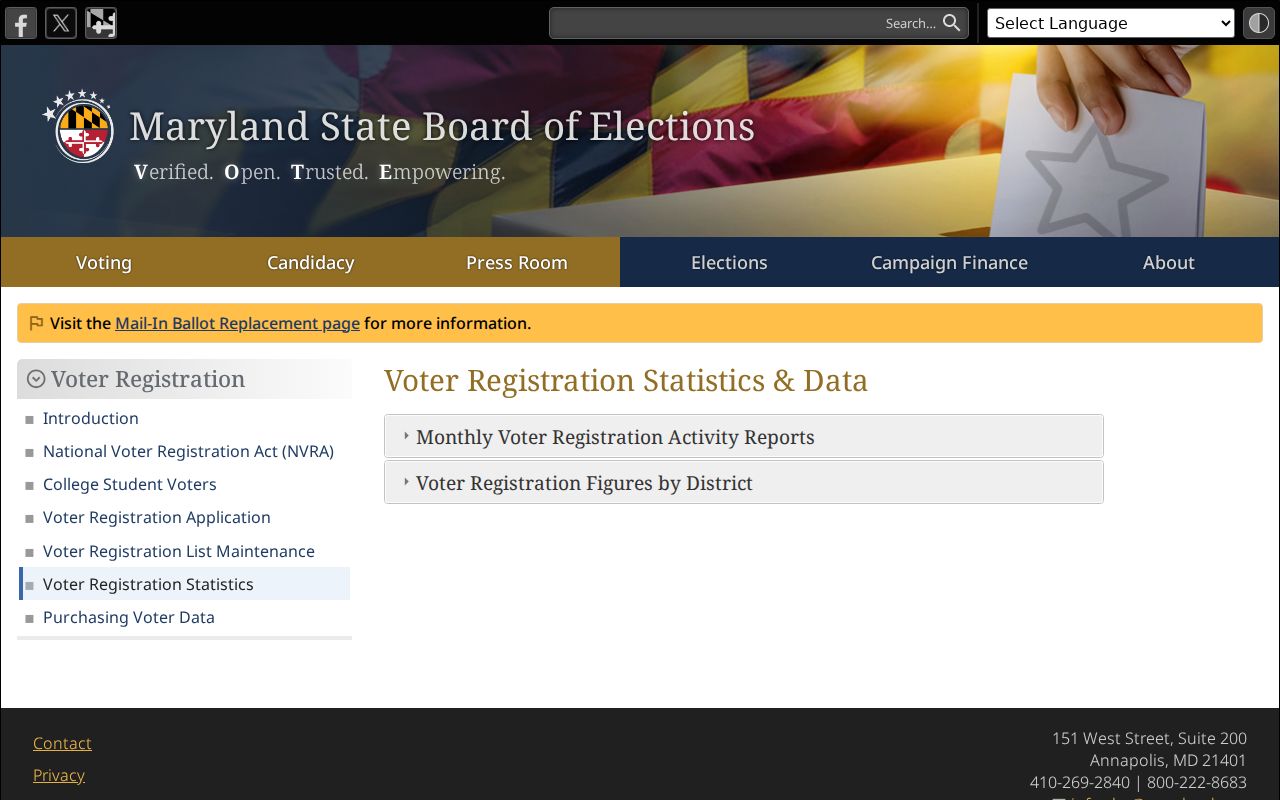
The report date matters because totals and party registration change. A defensible Fairland figure would require a supported precinct or district aggregation, not an estimate based on the community's population.
Historic Fairland Voter Record Trails
Modern electronic voter rolls are not the only election record trail. The Maryland State Archives catalogs Montgomery County Board of Registry voter registration records in series C3362 for 1896 through 1936 and 1944. Units are arranged by election district or precinct, year, and surname range. Earlier Montgomery poll books survive for 1884 through 1895 and are alphabetized within each district.
These old registers can support family history and civic research, but the search depends on historic election geography. A present-day Fairland address or postal label should not be projected backward without checking the district boundaries used in the record's own year. Use the Archives series citation, catalog, and ordering route, then compare the entry with deeds, census schedules, or newspapers.
That long span is the useful surprise: late nineteenth-century poll books and early twentieth-century registers preserve name trails that are separate from today's restricted electronic products. They also require more careful place work than a current ZIP-based lookup.